Recycling and Sustainability for Gardener Chessington
As a local Gardener Chessington service focused on sustainable practice, we design an eco-friendly waste disposal area and an efficient, low-impact sustainable rubbish gardening area that fits both private gardens and shared green spaces. Our approach balances on-site composting, careful waste separation, and professional collection to reduce landfill and boost soil health across the borough.Our mission as a gardener in Chessington is to create resilient green spaces while cutting carbon and waste. We treat recycling as an integral part of garden maintenance: separating green waste, food scraps, wood, and dry recyclable packaging at source. This reduces contamination and improves the value of material sent to local processing. We work with residents and estate managers to adopt the borough-style waste separation system—glass, mixed recycling, food/garden waste and residual streams—so materials are reprocessed, not wasted.
Eco-friendly zones and transfer options
Our on-site eco-friendly waste disposal area includes designated bins and covered bays, clearly labelled to follow local transfer station standards. We coordinate with nearby transfer facilities and borough transfer hubs to ensure green waste and recyclables reach the right processing plants quickly. Key routes include collection links to the borough transfer stations and regional processing hubs, minimising double-handling and keeping carbon emissions low.Recycling targets and measurable aims
We have set a clear recycling percentage target for our gardening operations: a 65% recycling and diversion rate by 2030, with interim targets of 52% by 2026. These targets cover organic recycling, timber reuse, metal and plastic recovery, and textiles. Tracking is done per project so our Chessington gardener teams can report progress and refine processes to improve separation and recovery rates.To hit these targets we prioritise:
- On-site segregation of compostable materials and clean timber
- Reuse of stone, pavers and hard landscaping where possible
- Donation or resale of functional garden tools and salvageable planters
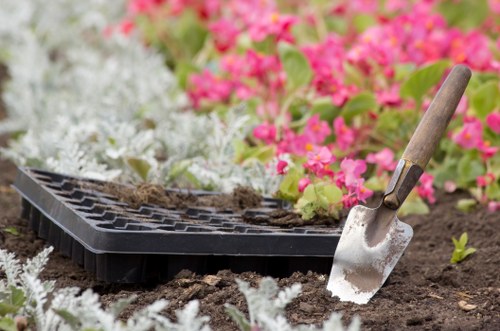 Our sustainable rubbish gardening area also includes a modular composting system and mulching station so green waste is turned back into soil resources quickly. We operate community drop-off points for small-volume household garden waste and coordinate with local authorities on permissible composting volumes, ensuring compliance with borough clearance and fly-tipping rules.
Partnerships with charities and community groups are central to our model. We actively partner with local horticultural charities, community orchards, and reuse networks to rehome plants, tools and surplus soil amendments. Strong relationships with social enterprises and food redistribution groups mean any edible surplus from maintained edible gardens is diverted to community kitchens rather than wasted.
We also collaborate with local environmental charities and volunteer groups for seasonal clearance days and habitat restoration projects. By redirecting reusable materials through charity channels, our gardening services Chessington practice supports local social benefit and extends the useful life of many garden items.
Operationally, our fleet is transitioning to low-carbon vans—electric and plug-in hybrids—supported by route optimisation software and telematics to reduce idling and unnecessary mileage. Low-emission vehicles are used for collection runs to transfer stations and charity drop-offs, minimising the carbon footprint of each job while maintaining reliable service.
We also support borough-level recycling activities and public schemes: promoting kerbside food-waste caddies, garden waste collections, and community bring-banks for glass and textiles. These light, practical measures align our Gardener, Chessington operations with wider municipal waste separation policies so that materials leave the garden correctly sorted and re-enter the local recycling stream.
Practical on-site measures include material audit sheets for every project, staff training in contamination avoidance, and labelled containment for separated streams. Our crews are trained to segregate paper, plastics, bulky timber, and hazardous materials (like treated wood) and to handle each stream according to transfer station acceptance criteria. This reduces rejections at local hubs and keeps processing efficient.
 Before completing a job we provide clear documentation of how waste was handled and where recyclable materials were taken.
  Ultimately, our sustainable approach to landscaping and waste—combining composting, reuse, charity partnerships, borough-aligned separation and a low-emission fleet—creates a replicable model for greener gardening across Chessington, helping local residents meet higher recycling ambitions while enjoying healthier, more resilient gardens.